
Mt Egerton Project
Why Victoria?
- Bendigo-Ballarat zone known to be a premier gold producer having produced over 80Moz of gold and contains the two highest-grade significant producing gold mines in Australia – Fosterville >200koz/y @ 10.5g/t (also the highest margin gold mine in the world) and Costerfield >50koz/y @ 12.4g/t – Both owned by Canadian companies.
- In addition to the above two operations the latest exploration success is Southern Cross Gold’s Sunday Creek deposit. This has no MRE and yet SXCG has a market cap of over CAD$1.5B – testimony to high-grade gold success – Also owned by a Canadian company. Raised AUD$143million in April 2025. Only drilled to ~80m before SXCS began exploring.
- All of the above mines were historical producers that are the result of modern exploration within and beneath the old workings – none have been closed off at depth and all increase in grade with depth. Deepest intercept at Sunday Creek – 3.6m@124.8g/t from 1,120.4m and still open
- Opportunity for an Australian backed, Australian managed, and Australian listed company looking to be one of the new Victorian success stories. Site favourably located for easy investor visits
- Little exploration in last 20 years as perceived to be too difficult to operate in – government has recently implemented strategies to fast-track mining approvals with WIM Resources’ Avonbank, VHM’s Goschen and Astron Corp’s Donald projects being approved for mining in the past 12 months – first granted in nearly 20 years. Multiple exploration licences have also been granted.
Mt Egerton – The Opportunity
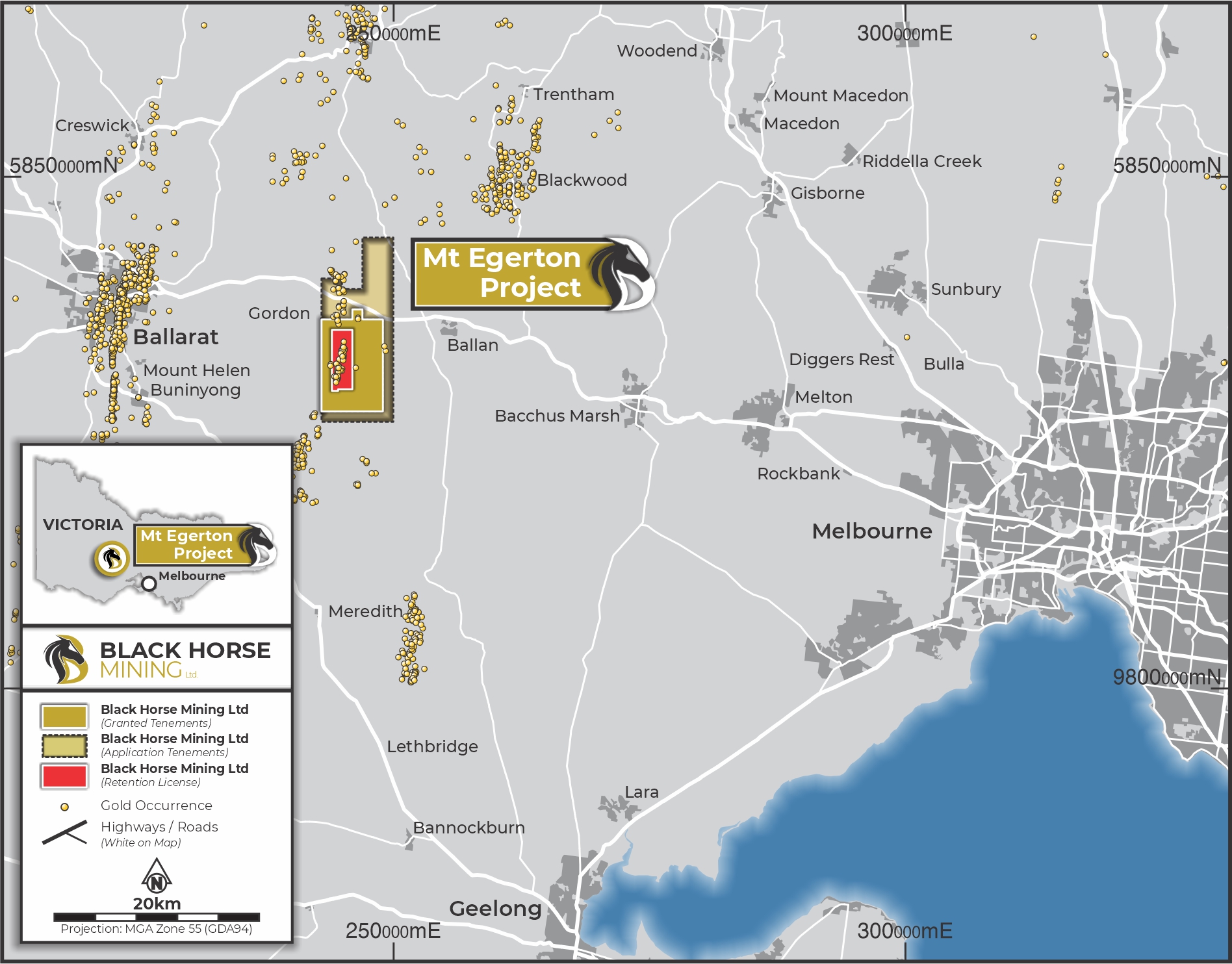
- 90 km WNW of Melbourne; 30 km from Ballarat.
- Gold discovered in 1853; mined until 1906.
- ~1.29 Moz Au produced @ 5.5–19.3 g/t (average around 1/2oz/t).
- One of only eight Victorian gold mines to produce over 1Moz from primary sources (not alluvial).
- Water ingress led to closure.
- One of the few significant historical gold mines in Victoria that has not had extensive recent work – tied up by private owner for 25 years.
- Limited drilling; <10% >150m depth (average ~120m) – results show potential for unmined high-grade shoots – 7m@18g/t from 84m, 4m@26g/t from 34m, 10m@10g/t from 97m, 24m@4g/t from 88m, 14m@4g/t from 57m, 5m@11g/t from 55m, 10m@5g/t from 16m, 6m@8g/t from 57m, 4m@10g/t from 133m.
- Extensions of mined shoots open below 550m depth.
- Parallel lines of workings not investigated for Mt Egerton style repeats.
- Fosterville, Costerfield, and Sunday Creek recent proven analogies of Mt Egerton – historical mines that have been extended below the old workings with new blind shoots discovered. None of the significant historical Victorian mines have been closed off at depth and show increasing gold grade with depth.
Tenure
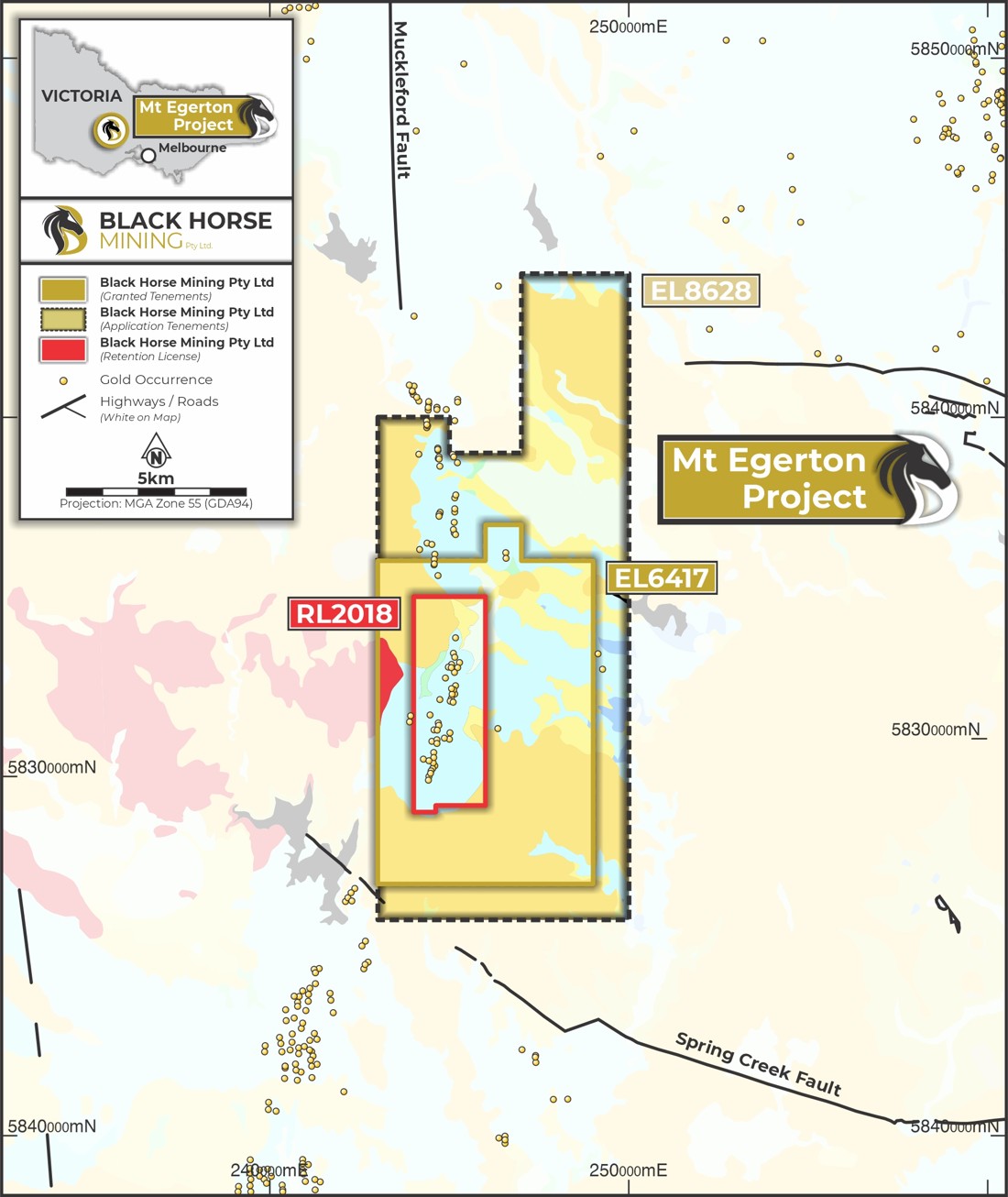
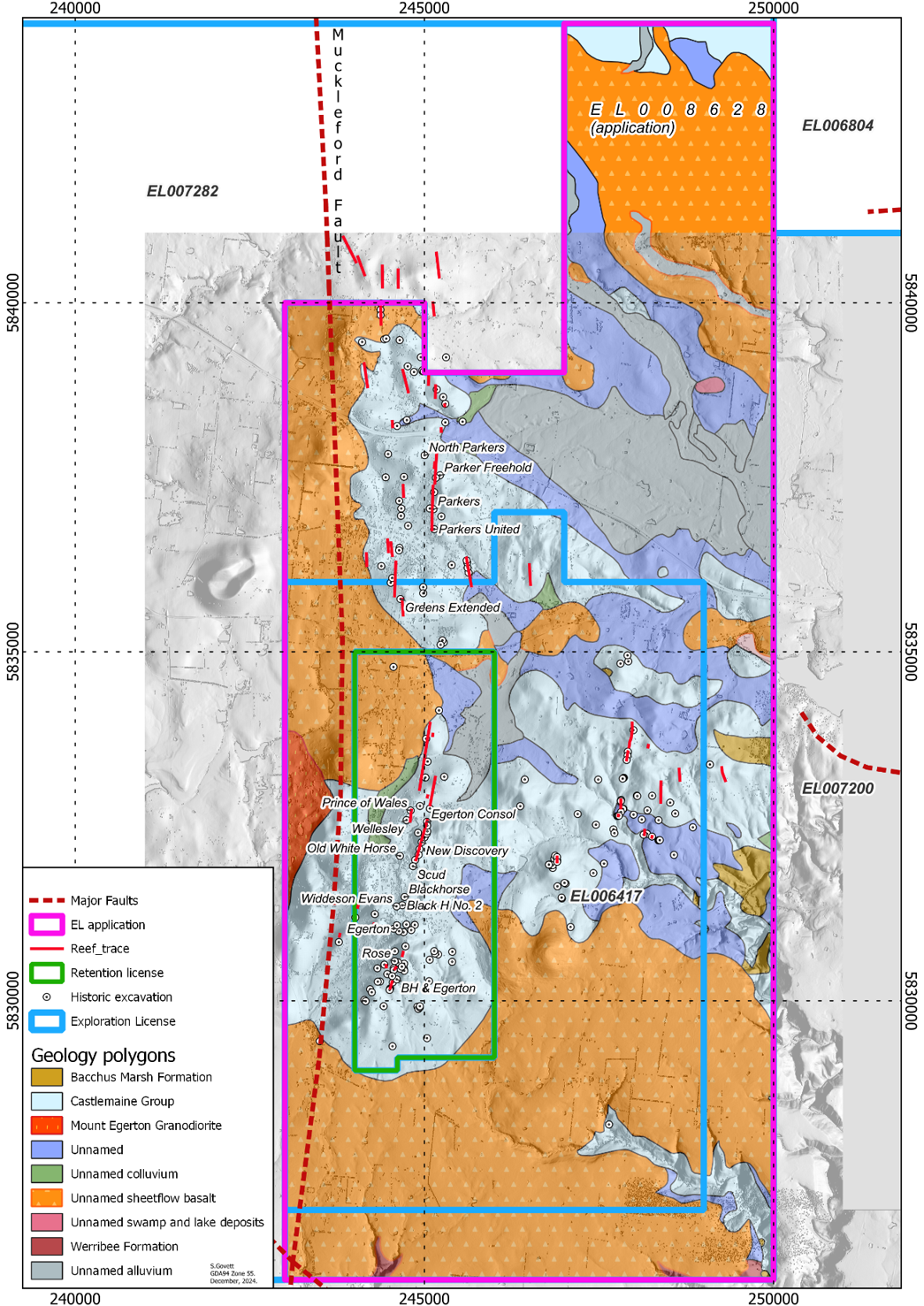
- One Retention Licence which covers the Mt Egerton gold mines
- One granted Exploration Licence which surrounds the Retention Licence and hosts other numerous gold occurrences
- One Exploration Licence Application (EL8628) which surrounds the granted Exploration Licence – also hosting numerous gold occurrences, including the historical Gorden goldfield
| Tenement Grant (Application Date) | Expiry Date | Area | Status | Registered Holder | Ownership Interest |
|---|---|---|---|---|---|
| RL 2018 25 October 2016 | 24 October 2030 | 1174.4 hectares | Current | Steadfast Mining Services Pty Ltd | 100% |
| EL 6417 17 November 2017 | 16 November 2027 | 45 graticular sections | Current | Steadfast Mining Services Pty Ltd | 100% |
| EL 8628 (16 December 2024) | 53 graticular sections | Application | Steadfast Mining Services | 100% |
Potential
3D Geological Modelling
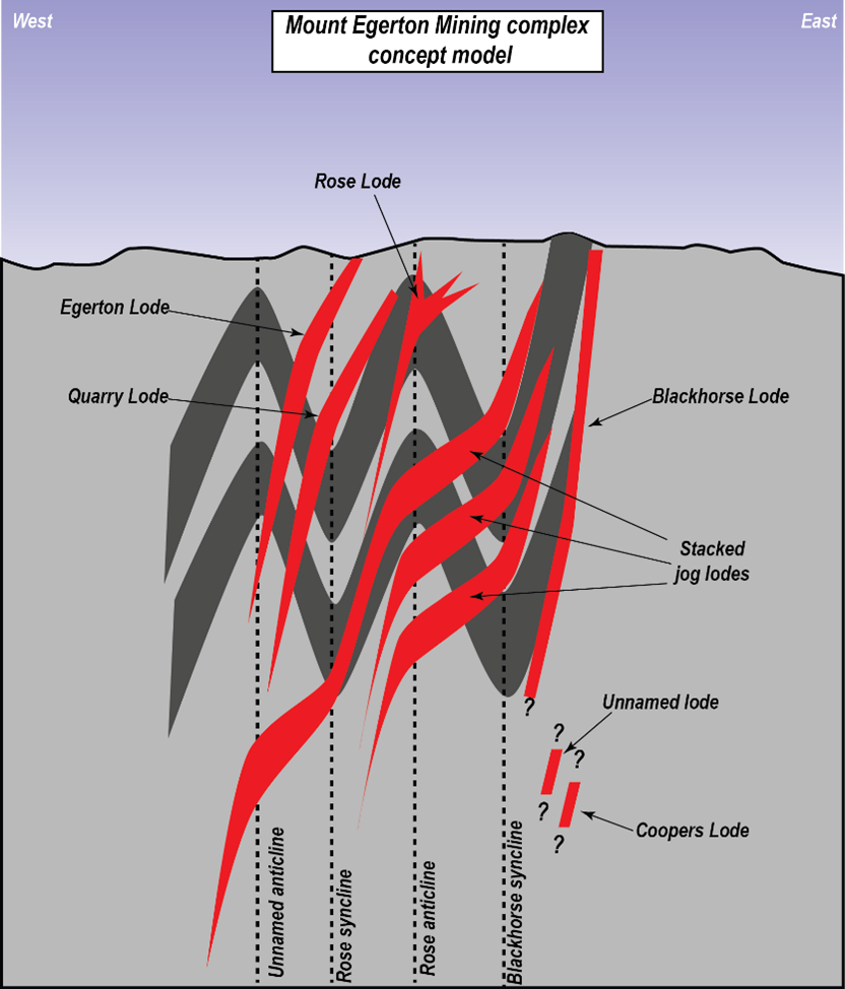
- transformed historical data, including drilling, mine plans, sections, long sections, and level surveys, into a comprehensive three-dimensional wireframe model of the Mount Egerton mining complex.
This model has revealed:
- Remnant lodes intersected in historical workings, extending from approximately 200 meters to beyond 500 meters below the surface.
- Evidence of undiscovered lodes in near surface drilling, particularly within the Rose syncline, Rose anticline, and Black Horse syncline.
- Potential for additional lodes in parallel structures, as indicated by unnamed synclines and anticlines with historical workings.
- Lodes intersected in deepest part of the mine “continuing strongly to depth” (beyond 550m depth) left unmined due to water ingress which eventually closed the mines
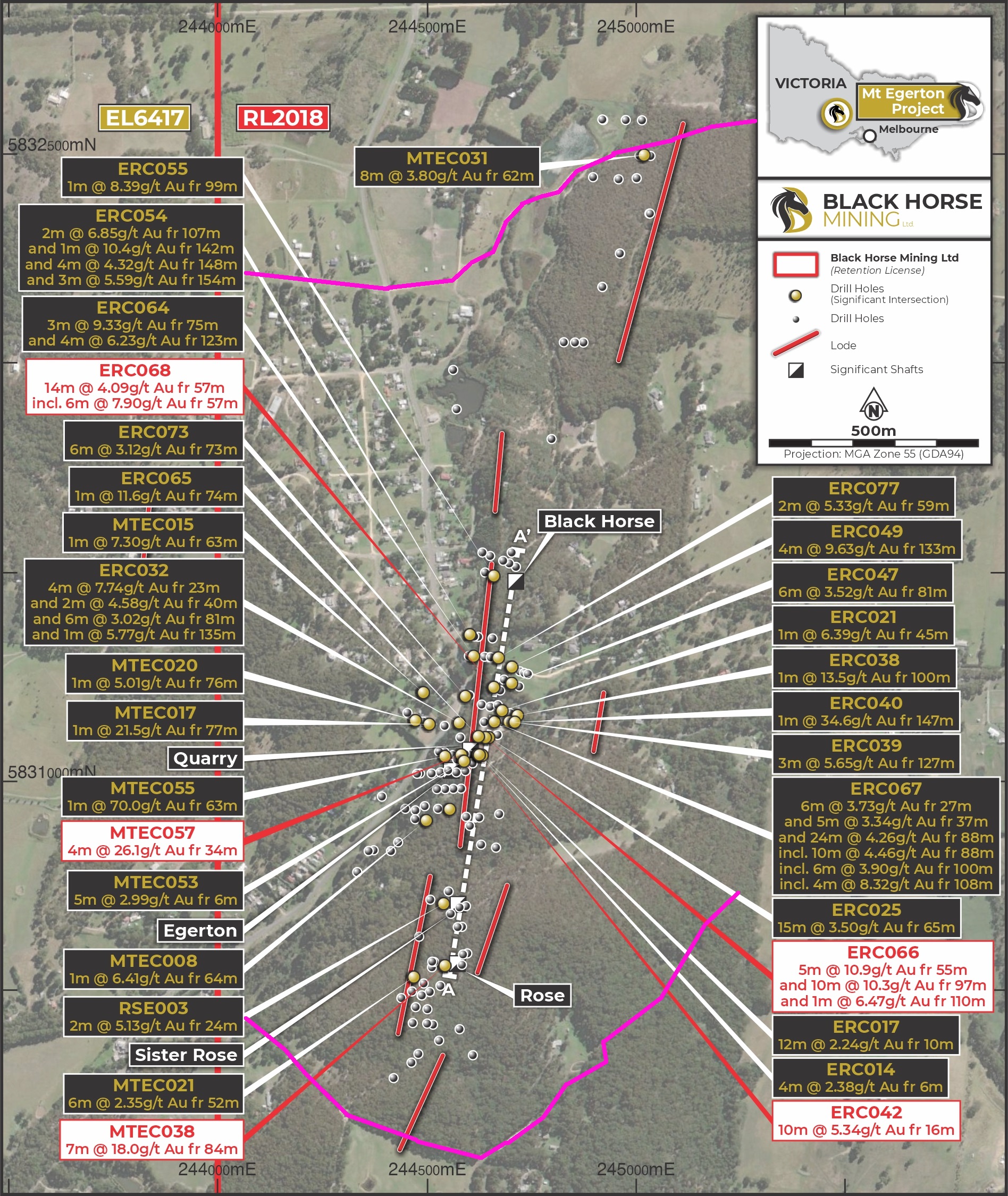
- Mt Egerton only mined to c.550m below surface – Fosterville orebody nearly 2,000m and still going, Ballarat c. 1,000m and not closed off. Egerton also not closed off
- Top of old shafts filled in but workings likely still intact.
- ~1.29 Moz Au produced @ 5.5–19.3 g/t (average around 12g/t)
- Water ingress led to closure
- Limited drilling; <10% >150m depth – results show potential for near surface unmined high-grade shoots
- Extensions of mined shoots open below 550m depth
- Parallel lines of workings not investigated for Mt Egerton style repeats
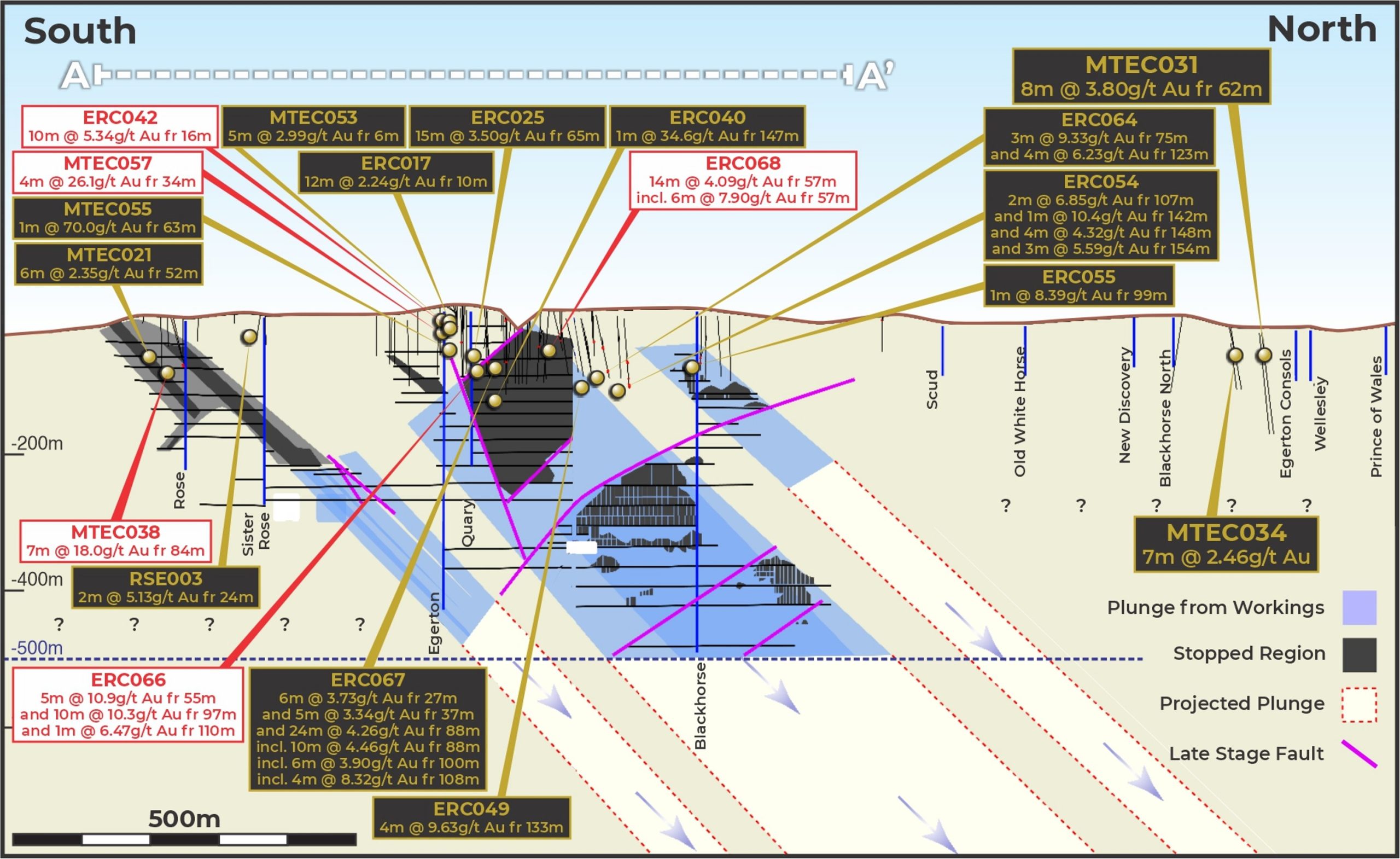
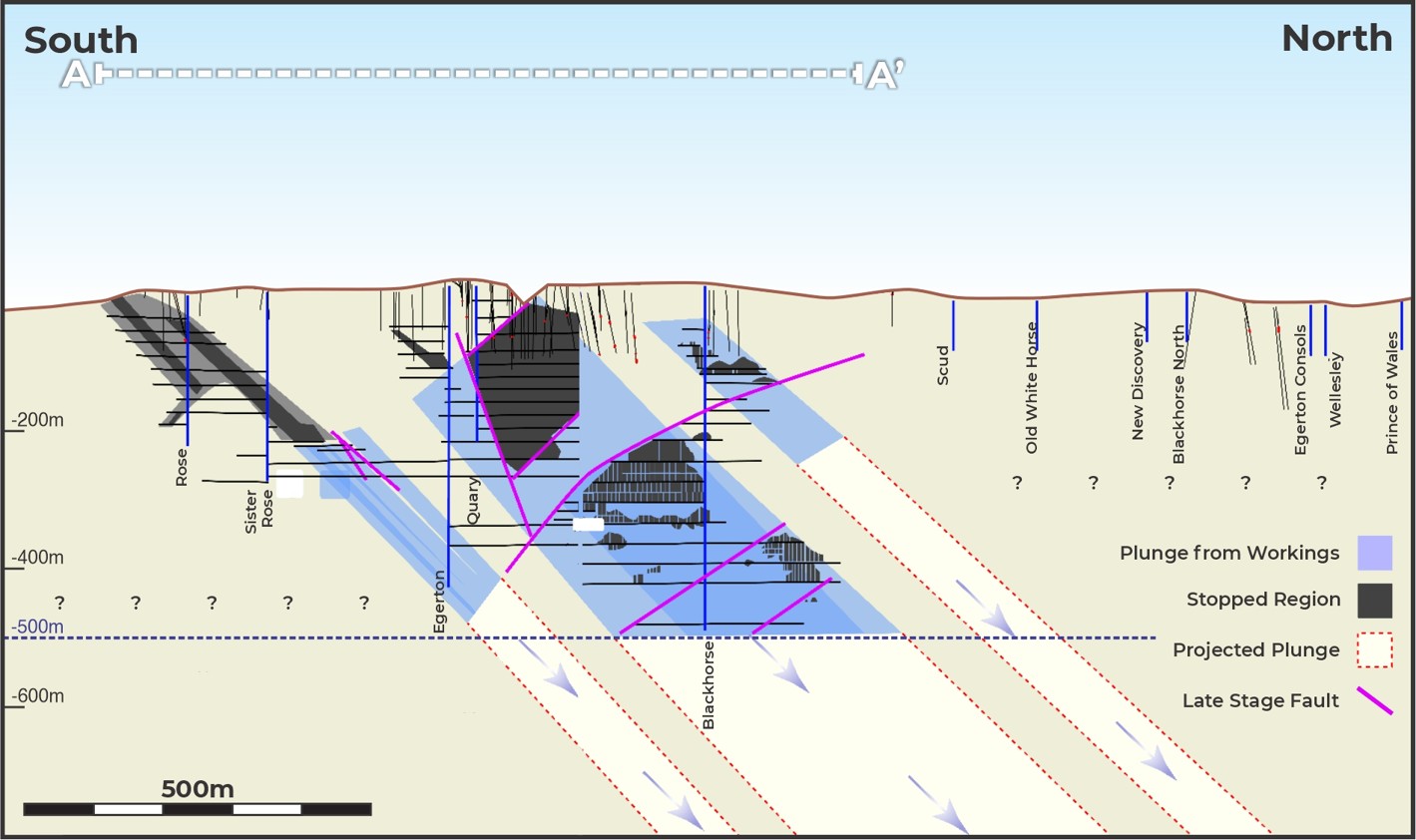
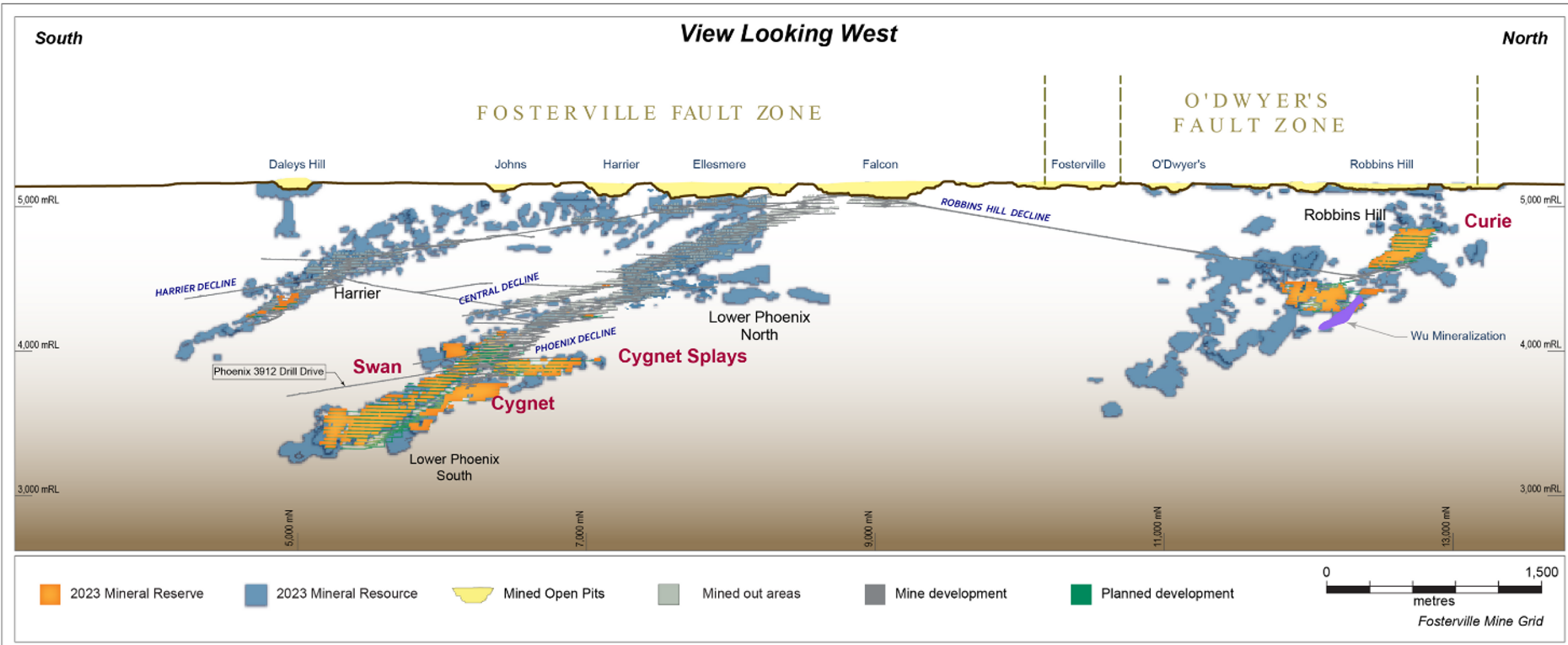
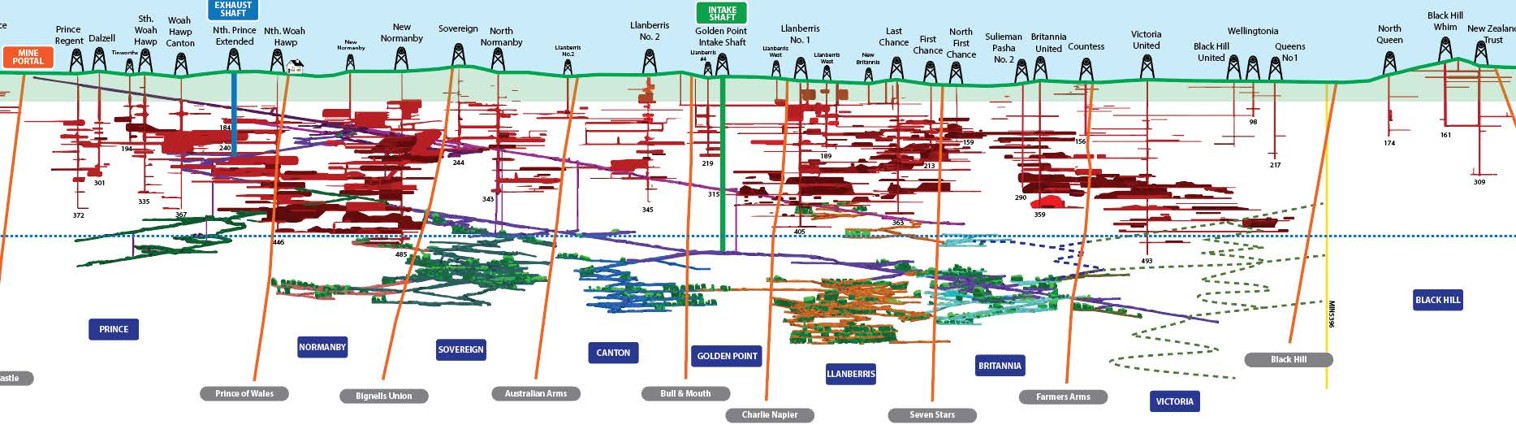
Mount Egerton, Fosterville, and Ballarat long-sections. Blue dashed line is c. 500m depth. Evidence suggests that Victorian gold deposits increase in gold grade with depth and none have been closed off at depth. Mt Egerton 500m – Fosterville 2,000m – Ballarat 1,000m and still open at depth.
Regional Potential
Exploration Potential Beyond Main Corridor
- Areas to the north, east, and south of the main Egerton mine corridor exhibit significant exploration potential, as identified through LiDAR imaging and historical records.
- LiDAR-Identified Excavations – Hundreds of shallow, largely undocumented excavations have been detected in outcropping Ordovician basement rocks, indicating past mining activities.
Devlin’s Paddock
- Historical workings at Devlin’s led to the formation of the Golden Dyke Company in 1894, based on gold discoveries.
- In 1884, a shaft at Devlin’s reached a depth of 100 ft, with reports of stone containing substantial precious metal content.
- The area aligns with a trend of surface workings evident from LiDAR data.
Whipstick State Forest
- Multiple trends of shallow excavations are observed to the east, suggesting further exploration opportunities.
Ballarat Road Sampling (2004)
Sampling of quartz veins revealed high values of gold, arsenic, molybdenum, and bismuth, indicating mineralization outside the main corridor.
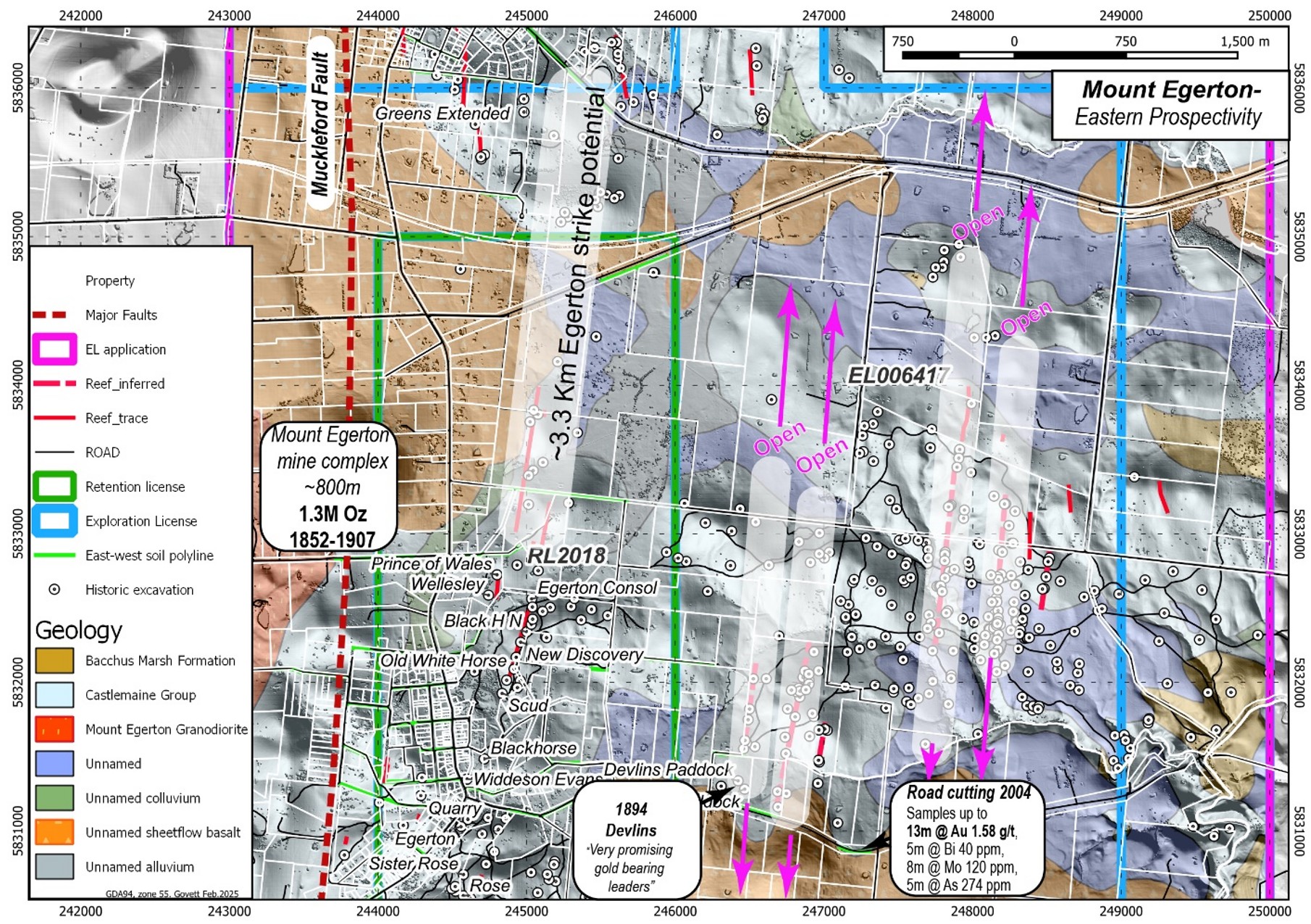
Mount Egerton eastern prospectivity. Surface geology and property boundaries draped over LiDAR. Shallow historic workings inferred from LiDAR and historic records of exploration annotations.
Southern Prospects
- ~1.6 km south of Egerton, three veins were tested; one reached a depth of 30 m with gold grades up to 1.5 g/t, while the other two showed trace amounts.
- Morris’s Paddock, ~4.8 km south, a small underground shaft was developed in auriferous drift and gravel near the margins of the Newer Volcanics.
Eastern Moorabool River Area
- LiDAR data reveals shallow surface excavations in Ordovician basement rocks along the eastern branch of the Moorabool River, indicating additional exploration targets.
These findings highlight the significant potential for discovering new mineralised zones outside the historically mined areas around Mount Egerton
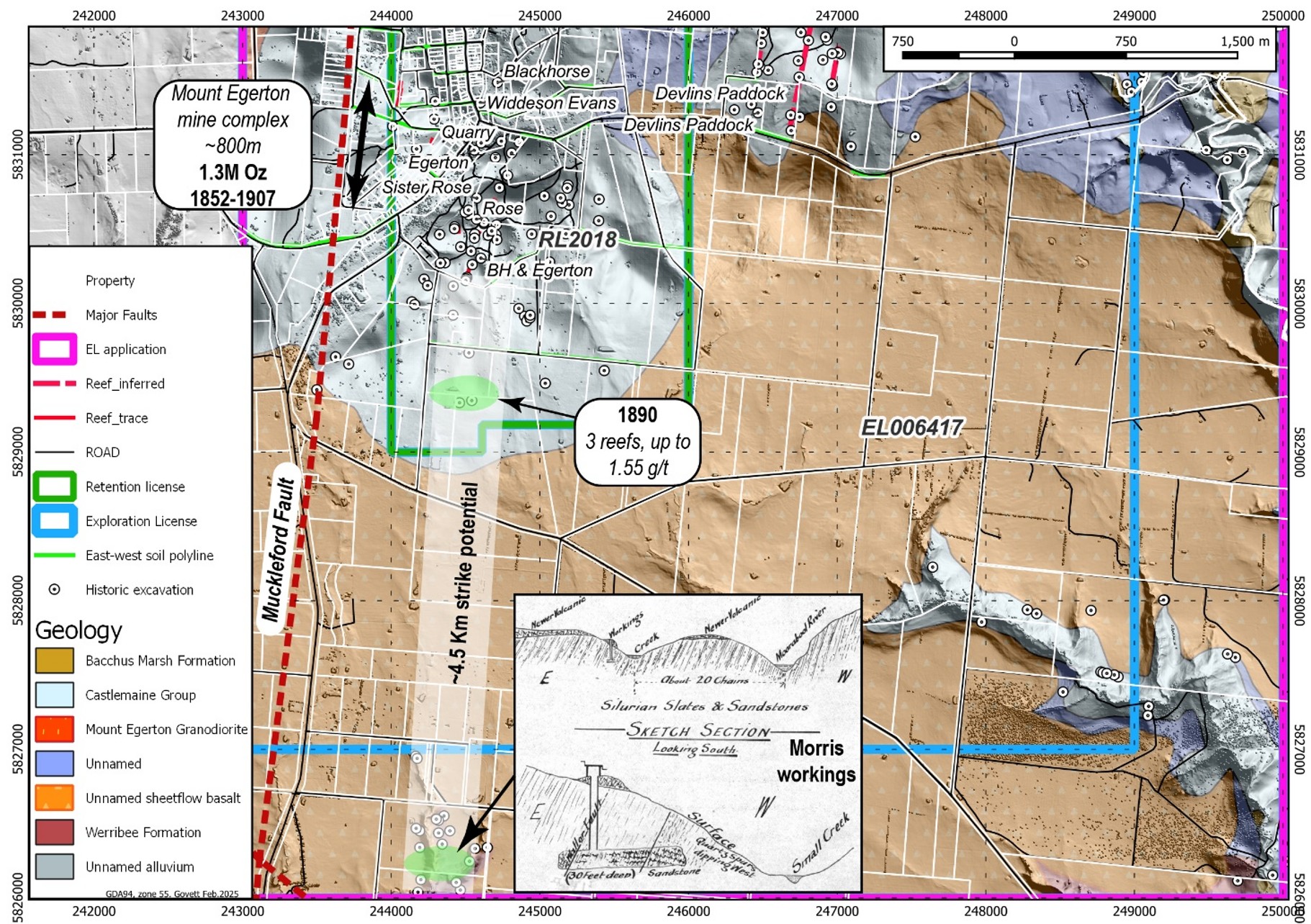
Egerton southern prospectivity. Surface geology and property boundaries draped over LiDAR. Shallow historic workings inferred from LiDAR and historic records of exploration annotated.